Caspar David Friedrich: The Soul of Nature
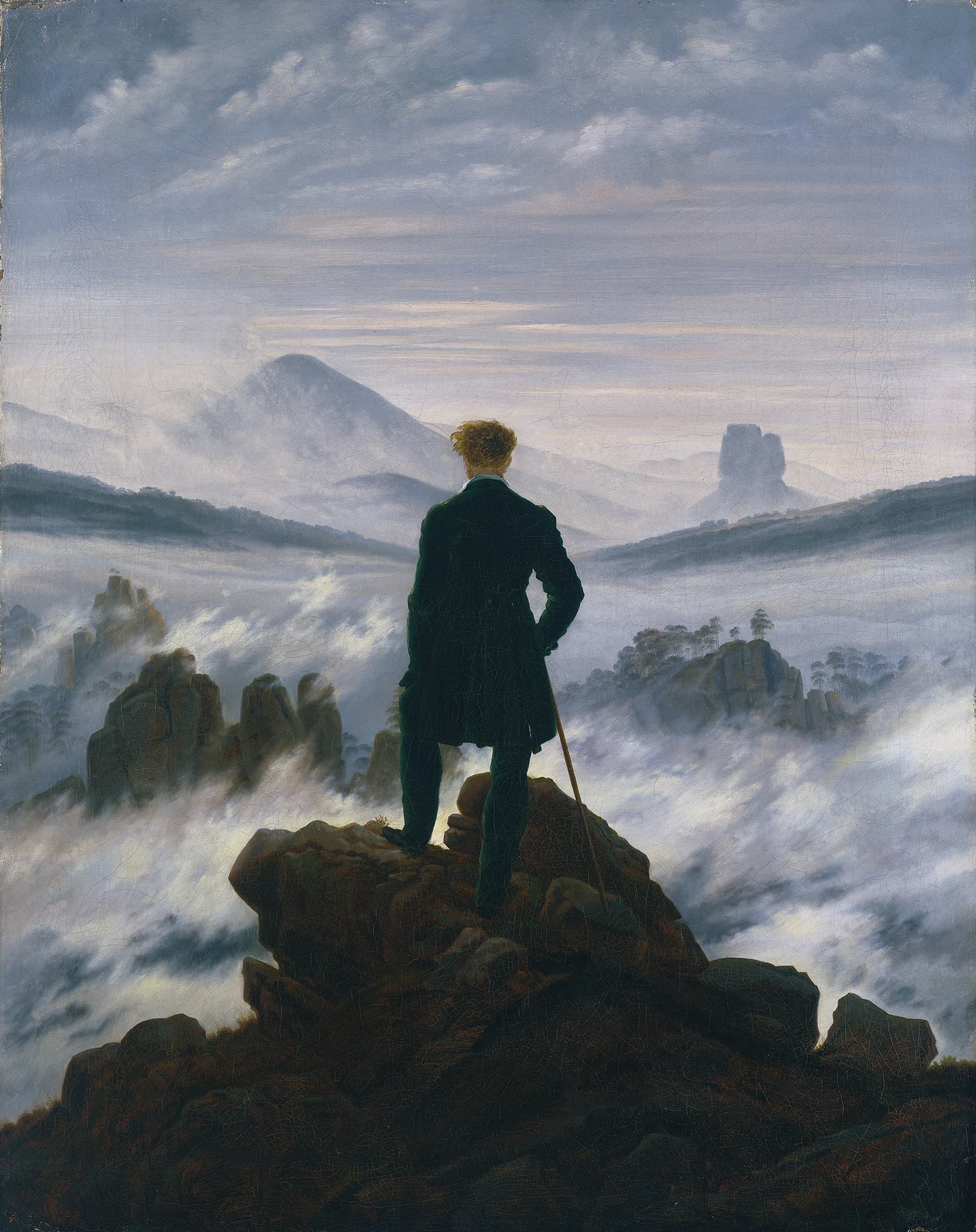
Caspar David Friedrich, Wanderer above the Sea of Fog, ca. 1817. Oil on canvas, 37 3/8 × 29 1/2 inches. Courtesy Hamburger Kunsthalle and the Met. Photo: Elke Walford.
Word count: 1428
Paragraphs: 15
The Metropolitan Museum of Art
February 8–May 11, 2025
New York
Once upon a time, I made a pilgrimage to Berlin to stand before Caspar David Friedrich’s painting Monk by the Sea (1808–10). Its beauty, and the tiny lone figure standing on a slip of sand at dusk, facing a dark sea blending into an enormous turbulent sky, spoke to me. The scene expresses the thrill of withstanding a winter storm on the beach, physically isolated but not really, the self—the monk’s and mine—merging with the cosmos. I could have taken an evening stroll on the closer Rockaway beach. But better than the real thing was immersing myself in the emotional truth of Friedrich’s mix of melancholy and mysticism.
Now the Monk is by Fifth Avenue, a star attraction in the Metropolitan Museum of Art’s spectacular Caspar David Friedrich: The Soul of Nature. The show is the first major survey of his paintings and drawings in the United States. Only five Friedrich paintings are owned by US museums; many of the more than seventy-five works in oil, pencil, and ink came from substantial repositories of Friedrich’s work at the show’s German co-organizer museums in Berlin, Dresden, and Hamburg. In our volatile world, their generous gestures of faith, and those of other public and private collections, enabled Friedrich’s Monk and many others to be displayed in this country for the first time. Fortunately, as his oeuvre is not large, this is not one of the Met’s daunting exhibitions of just too many galleries. The size is just right.

Caspar David Friedrich, Monk by the Sea, 1808–10. Oil on canvas, 43 5/16 x 67 1/2 inches. Courtesy Nationalgalerie, Staatliche Museen zu Berlin and the Met. Photo: bpk Bildagentur / Nationalgalerie, Staatliche Museen zu Berlin / Andres Kilger / Art Resource, NY.
At 43 by 67 inches, Monk by the Sea turns out to be one of Friedrich’s largest paintings. The Met’s installation isolates it on its own wall, facilitating a long view from the preceding gallery. That positions the viewer parallel to the monk’s stance facing an expansive environment. Its theme of misty contemplation replaces French neoclassicism’s reasoned volumetric clarity with Romanticism’s suggestive tonal expression. The simplified composition—underpainting indicates that Friedrich removed ships on the horizon—leans toward abstraction. Robert Rosenblum famously demonstrated that on the cover of his innovative 1975 Modern Painting and the Northern Romantic Tradition: Friedrich to Rothko by juxtaposing Friedrich’s soft bands of sand, sea, and sky alongside Mark Rothko’s cottony stack to argue Friedrich’s landscapes of longing as crucial a precedent to modernism as conceptual French Cubism. At Pace Gallery last month, photographer Richard Misrach’s nocturnes and daybreak seascapes of cargo ships stilled during the pandemic continues that meditative synthesis of representation and tonal abstraction but conveys our own era’s industrial commerce in nature.
Monk shares with several other compositions Friedrich’s signature motif of a figure observing terrain or sea and seen from the back—in German, a “Rückenfigur.” Wanderer Above the Sea of Fog (ca. 1817) has become Friedrich’s iconic image, yet it uncharacteristically inverts his customary Rückenfigur arrangement: its averted alpinist is in the foreground and at large scale, erectly extending a pinnacle crag. That and the sharply defined dark suit differentiate him from the fog billowing below and as an urban bourgeois. Is it thought that in this picture and others Friedrich’s idealization of characteristic Teutonic mountains, in contrast to the French fields and vineyards of recently vanquished Napoleonic invaders, amounts to an assertion of political allegiance.
More significantly, in addition to portraying pride in peaks, the composition’s spatial relations model humans’ dominance over them. That is, Friedrich’s Wanderer foretells the twenty-first century geological concept of the Anthropocene: humankind’s possession and alteration of nature’s fundamental characteristics. His lifespan was contemporaneous with the Industrial Revolution (considered the beginning or acceleration of the Anthropocene), but Friedrich does not appear to have been aware of it. As Friedrich scholar and catalogue contributor Joseph Leo Koerner noted to me, “CDF never set foot in England, [and] unlike his British contemporaries Blake and Wordsworth, there seems to be little ‘criticism’ of the ‘dark Satanic mills’ in his art.” Rather, as alert artists do, Friedrich’s Wanderer implicitly manifests contemporary social assumptions. It is we, viewers centuries later, who recognize his scene’s implications. The Met’s placement of Wanderer on the cover of its exhibition catalogue (prompting confusion with other hefty tomes on Friedrich) and on the huge banner out front tacitly herald humans’ species primacy—comforting to some, painful to others—promotes this obsolete instrumentalism of nature as humans’ resource.

Installation view: Caspar David Friedrich: The Soul of Nature, The Metropolitan Museum of Art, New York, 2025. Courtesy the Met. Photo: Richard Lee.
Yet however popular as Friedrich’s avatar, that bold overlord is anomalous in his introspective oeuvre. Predominately, his figures are in moderate scale and introverted, sometimes hardly distinguishable from the terrain, immersed in a radiant sunset or absorbed by twilight vistas. Many scenes are dreamy slate-blue nocturnes of stratus clouds obscuring the moon, which curator Alison Hokanson aptly describes as the “quintessential emblem of Romantic mystery and melancholy.”
So, they’re not only blue in hue but in mood; the Met’s catalogue essays and wall texts frequently note a veil of sadness. Friedrich’s portraits of spindly branches twisting from stalwart trunks and of ruins of Gothic churches intimate a struggle between resilience and desolation. Images taken to be testaments of his religious devotion actually fixate on death, depicting the Crucifixion or Christ’s chief mourner, his mother. The destination of A Walk at Dusk (ca. 1830–35) is a moonlit dolmen, found in Friedrich’s native Pomerania and also appearing in other images. The large boulders served as prehistoric grave markers; this one resembles a supine body. Before it, the walker’s bowed head above joined palms portends prayer and mourning.
Every work of art is more or less a latent self-portrait. Friedrich’s suffering of successive family tragedies is known. His mother died when he was seven, the next year, a sister; five years later he witnessed a brother fall through the ice on a lake and perish; four years after that another sister died. That series of disappearances gives another resonance to Friedrich’s rendering of figures turned away from the viewer, only partially known. Bereft of the comforts of maternal care, Friedrich found succor in the ancient conceit of “mother” nature. His early painting View of the Elbe Valley (1807) is said to have dismayed viewers for its elevation of landscape as subject matter over academic figuration in religious and history painting and its utter absence of people. But it does suggest personalization. Taking the robust group of hilltop spruces as stand ins for confident hikers/observers explains the oddly askew shorter one a few feet to the side, as if a wounded outsider.

Caspar David Friedrich, The Watzmann, 1824–25. Oil on canvas, 53 1/8 x 66 7/8 inches. Courtesy Nationalgalerie, Staatliche Museen zu Berlin and the Met. Photo: © DeA Picture Library / Art Resource, NY.
You won’t find integration of Friedrich’s biographical subjectivity in the Met’s presentation, which emphasizes formal analysis (sensitively observed) and stylistic and social history. The absence seems to assume that after losses of intimates one can “move on,” get past the past, losses get lost. Rather, Friedrich’s reiterated melancholic subject matter and handling demonstrate what literary critic Richard Stamelman has described as:
Like a moth circling a flame in an arc of fatal fascination, the image moves in a … self-representing pattern around the event of the past it wishes to carry back into the present. Its … quest to repossess the past produces a proliferation of signs and an excess of meaning that seek to compensate for the inadequacy of the representational process.1
Thus, the repeated wrestle with loss. At times, particularly toward the end of his life when his elegiac nocturnes fell out of favor, Friedrich was able to lift his spirit and paint daytime clarity.
This is Friedrich’s gift to the viewer, and the Met’s. Soul of Nature is as much about the nature of the soul, one that finds solace in creating and experiencing art. When originating this show years ago during the pandemic, the Met could expect the wide allure of Friedrich’s expressive landscapes, so rarely presented. But viewed today in a suddenly destabilized world, their undercurrent of grief speaks to our own experiences of loss. Art is consolation, but it is also demonstration, of choosing inwardness and individuation over groupthink—and the rewards of reflection and autonomy, which can stimulate action.
P.S. As Soul of Nature is drawing many visitors, try to arrive at the Met during the week (it is closed on Wednesdays) and at its opening hours. Enter south of the steps at the ground level 81st street opening, where the lines for both coat check and tickets are shorter. With appreciation to Joseph Leo Koerner for promptly sharing his expertise; dedicated to Walter Robinson, an incisive artist/critic, my editor at Artnet Magazine for a decade, and friend, uncharacteristically absent from the Friedrich press preview, then gone, a loss that will not be lost.
- Richard Stamelman, Lost Beyond Telling: Representations of Death and Absence in Modern French Poetry (Ithaca and London: Cornell University Press, 1990), p. 10.
Suzaan Boettger is an art historian and critic in NYC and author of Inside the Spiral, and The Passions of Robert Smithson.